

Certainly! Here is a detailed, reference-rich article on your requested topic:
From Learners to Experts: How Rawalpindi’s Traffic Police Train Safe Drivers
Table of Contents
- Introduction
- The Multi-Stage Driver Training Program
- The Role of CTO Beenish Fatima
- Modern Training Tools: Simulators & E-Learning
- Legal Framework for Licensing
- Public Awareness & Community Involvement
- Success Stories & Impact
- Conclusion
- FAQs
1. Introduction
Ensuring road safety begins with driver education. Rawalpindi’s City Traffic Police (CTP), under the leadership of CTO Beenish Fatima, has developed a progressive training approach that transforms learners into skilled, responsible drivers. Their mission: safer roads for all.
2. The Multi-Stage Driver Training Program
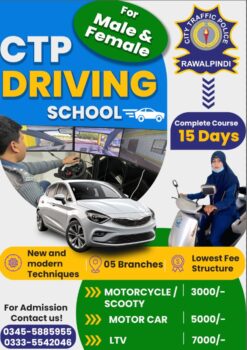
CTP Rawalpindi’s training school offers a structured pathway:
- Theory Classes: Cover traffic rules, road signs, defensive driving, and first aid (in line with Rule 8, Motor Vehicles Rules, 1969).
- Practical Sessions: On-road practice with instructors for handling real-life scenarios—traffic signals, roundabouts, and emergencies.
- Simulator Training: Virtual driving using a state-of-the-art simulator to safely experience diverse traffic situations before venturing onto actual roads.
- Mock Tests: Regular assessments to prepare for the licensing exam, ensuring knowledge and confidence.
3. The Role of CTO Beenish Fatima
Chief Traffic Officer Beenish Fatima is known for her innovation and public-focused reforms:
- Introduced women’s driver training batches and female instructors.
- Increased school and college outreach for youth awareness.
- Included special scooty training, theory and mechanical, reverse, highway, LTV and road safety courses.
Her philosophy: “Safe driving is a community investment. Every good driver makes Rawalpindi safer for all.”
4. Modern Training Tools: Simulators & E-Learning
- Driving Simulators: Realistic 3D scenarios for practice—night driving, rain, emergency braking.
- E-Learning Modules: Online lessons, quizzes, and interactive road safety campaigns for continuous learning.
5. Legal Framework for Licensing
Training is closely aligned with Pakistan’s laws:
- Section 7, Provincial Motor Vehicles Ordinance, 1965: Mandates passing a driving test.
- Rule 8, Motor Vehicles Rules, 1969: Specifies driver training syllabus.
- Emphasis on helmet use (Section 89-A) and prohibition of unlicensed driving (Section 3).
6. Public Awareness & Community Involvement
- Workshops in colleges, factories, and public spaces to spread road safety awareness.
- Community events, road safety quizzes, and parent-child sessions.
- Social media campaigns highlighting the importance of defensive driving and legal compliance.
7. Success Stories & Impact
- Notable reduction in first-time accident rates among newly licensed drivers.
- Growing number of women drivers and youth license holders.
- Recognition for CTP Rawalpindi’s training program from citizens and safety advocates.
8. Conclusion
Rawalpindi’s City Traffic Police have redefined driver training—combining legal compliance, modern technology, and community outreach. From learners to experts, every driver trained under CTO Beenish Fatima’s leadership contributes to a safer, more responsible city.
Download Our Sign Test App

9. FAQs
Q1: Is simulator training mandatory for all new drivers?
It is strongly encouraged and may become a requirement in the future.
Q2: Can women enroll in all training programs?
Yes, with special batches and support for female trainees.
Q3: How do I register for driver training in Rawalpindi?
Visit the traffic Headquarters or your nearest licensing center.
Q4: Are road safety workshops available for schools?
Yes, on request, CTP officers conduct sessions for students.
Q5: What laws back this training program?
Sections 3, 7, and 89-A of the Provincial Motor Vehicles Ordinance, 1965 and Rule 8 of the Motor Vehicles Rules, 1969.
Let me know if you need a description, catchy Urdu titles, or a featured image for this article!