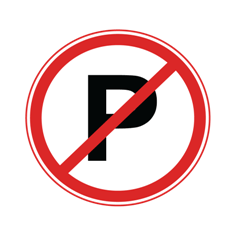
A “No Parking” sign tells you that you must not leave your vehicle standing at that spot. It is one of the regulatory signs that drivers are asked about in the licence test, and it is often confused with the “No Stopping” sign. This guide explains what the sign means, how to tell it apart from similar signs, and what to do when you see it.
What does the No Parking sign mean?
The sign usually shows a letter P inside a round sign with a red border and a red diagonal line through it. It applies to parking, which means leaving a vehicle standing. It is a regulatory sign, so you must obey it, unlike warning signs that only alert you to a hazard. Signs can differ in small details, so always read any plate or text under the sign too.
No Parking vs No Stopping
These two are often mixed up, and the difference matters:
- No Parking: you should not park or leave the vehicle waiting. Depending on the local rules and any plate under the sign, a very short stop to drop off or pick up a passenger may be allowed.
- No Stopping: you should not stop at all, even briefly, except in an emergency or when traffic forces you to. This sign usually has a stronger look, such as a cross instead of a single line.
If you are unsure which applies, treat it as the stricter one and do not stop there. Our free English sign test and Urdu sign test let you practise telling similar signs apart.
Where you will usually see No Parking signs
- Busy roads and markets where parked cars would block traffic.
- Near junctions and pedestrian crossings, where parked vehicles block the view.
- Outside hospitals, fire stations and other emergency services.
- Loading areas and bus stops, which need to stay clear.
- Narrow roads where a parked car would leave too little room for others to pass.
What to do when you see the sign
- Do not park within the stretch the sign covers. Check for an arrow, a plate or text that shows where the restriction starts and ends.
- If the sign has times or days shown, the rule applies only then. Otherwise assume it applies all day.
- Find another place before you reach the sign. Looking for a spot early is easier than moving a parked car later.
- If you need to drop someone off, stop only as briefly as the rules allow and never leave the vehicle unattended.
Why following the sign matters
- It keeps the lane clear, so traffic and emergency vehicles can pass.
- It keeps junctions and crossings visible for other drivers and pedestrians.
- It avoids a fine or having your vehicle towed. The penalties, and who can enforce them, depend on the local authority, so check with your city or traffic police for the rules where you drive.
Related reading: our full list of Pakistan road signs and their meanings.
FAQs
Can I stop for a few minutes in a No Parking zone?
It depends on the local rules and any plate under the sign. In general, brief stops to drop off or pick up passengers may be tolerated where parking alone is banned, but waiting or leaving the vehicle is not. Where a No Stopping sign is shown, do not stop.
What is the difference between No Parking and No Stopping?
No Parking bans leaving a vehicle standing. No Stopping is stricter and bans stopping altogether, except in an emergency or when the traffic makes you stop.
Does the sign apply all day?
Unless the sign shows days or times, assume it applies at all hours. If a plate shows times, the rule applies during those times.
Will my vehicle be towed?
This is up to the local authority. Vehicles that block traffic or emergency access are the most likely to be moved, so never park where you might cause an obstruction.